
How Honey Insurance is building a brand worth trusting
Honey Insurance launched five years ago with a unique proposition: what if an insurer helped prevent things from going wrong in the first place? We think that’s pretty radical.
Honey gives its home insurance customers $250 worth of smart home sensors on sign-up to help detect water leaks, fire hazards, even unsecured doors, and structures their whole brand around the idea of being proactive.
We recently sat down with Hanne Trafnik, Honey’s Distinguished Product Designer and founding team member, to talk about building trust in a low-trust category, brand decisions that made Honey look and feel like nothing else in the market, and why “smart” doesn’t equal technology.
Let’s start with the name. Honey is an unusual choice for an insurance company. Was that deliberate?
Hanne: Completely. When we started, it was very clear that we didn’t just want a product experience that was differentiated; we wanted a brand experience that went hand in hand with it.
For us to be noticeable in the market, we wanted to look different and sound different.
The name Honey is relatable, and something that evokes feelings. It’s a nice, soft word that has an existing positive meaning. And it addresses those traditional perception issues of insurers being cold, harsh or rigid.
We wanted to create a brand that people felt they could connect with — one they’d be comfortable calling, knowing they’d speak with someone who genuinely wanted the best for them.
And you’ve carried that warmth into the visual identity too. Can you walk us through your thinking?
Hanne: Yes, that was very intentional.
Insurance companies in our market are almost universally green or blue, it’s like an unwritten rule of the category.
We wanted to stand out without feeling aggressive, so we went with softer, warmer tones. But warmth on its own can tip into feeling lightweight, so we were very deliberate about balance. We paired the palette with a clean, Swiss-style typeface, something more sophisticated and structured. If we’d gone with a serif font on top of those warm colours, I think it could have felt twee rather than trustworthy. The typography is what keeps it grounded.
We also invested heavily in illustration and animation throughout the website and the sign-up experience, and that was a really considered decision, not just a stylistic one.
Insurance asks people to make quite abstract decisions. You’re essentially trying to get someone to think carefully about things they’d rather not think about; what happens if there’s a flood, what happens if there’s a fire.
A well-crafted illustration can make a complex or uncomfortable idea feel approachable and clear in a way that paragraphs of copy simply can’t. It reduces cognitive load at exactly the moment when you need people to be engaged, not overwhelmed.
And then the animation layer adds something else again; it brings the brand to life in motion, which is where a lot of brands stop short. Great animations mimic the best of the physical world. Like a soft-close cabinet door that moves fast at first, then eases to a gentle close — that feels amazing and satisfying. Adding animations from screen transitions to button click state makes our experience feel more considered and therefore more elevated than you might expect from an insurance brand.
We also animate our illustrations to add a touch of surprising delight (especially for pet insurance), but for us even the transitions and interaction states were part of our product experience foundation. For us, those little moments throughout the experience were a way of saying: we’ve thought about this. We care about how this feels.
Hero animation and small illustrations help welcome users to their account home page.
The traits of warmth, softness, care and connection are often described as being “feminine” when really they’re just human. Is that what Honey was going for?
Hanne: A gender dimension was never part of the brief. So it wasn’t that.
For us it was more that certain qualities like softness, warmth, genuine approachability just felt like a better way to communicate with people. Full stop.
Insurance has a long history of feeling harsh, transactional, almost adversarial. The experience of buying it, the language it uses, the way it behaves at claim time; it is uncommon for it to feel like the company is on your side.
We wanted to change that. And the qualities that help you do that — care, clarity, feeling like there’s a real human on the other end — those aren’t feminine traits. They’re just good traits.
“Feminine” is the word people sometimes reach for when they describe us, but it wasn’t the intention. It’s a label that lands on us from the outside.
What I do think is worth emphasising is that the qualities of care, clarity and warmth have historically been undervalued in financial services. The category has defaulted to projecting authority and scale by signalling that we are big, serious or established. And there’s a reason for that; those things do build a certain kind of trust.
But I think what people actually want from a financial brand — especially now — is something closer to: I feel like you understand me. I feel like you’d be in my corner if something went wrong. I feel like a person thought about my experience.
That’s not a gendered ask. That’s just a human one. And it’s been surprisingly underserved.
That instinct to simplify: where did it come from?
Hanne: Coming in with fresh eyes, honestly. A lot of our founding team, including me, didn’t have an insurance background. So, we kept asking: why does it have to be like this? Is there a way to reduce the number of questions? Can we rephrase them? Can we take on a little risk and remove some questions entirely?
That’s how we got the sign-up flow down to three minutes. At the time, five years ago, that was quite rare. Insurers weren’t really trying to communicate in that way. We tipped the underwriting requirements on their head and genuinely questioned each one.
The advantage we had was a clean slate. When you’re not building on top of an existing product, you have real opportunities to innovate. Whereas if the foundation is already there, it’s much more challenging to push against something that’s working and hasn’t generated complaints. It’s very easy to end up with a ‘if it’s not broken, don’t fix it’ mentality.
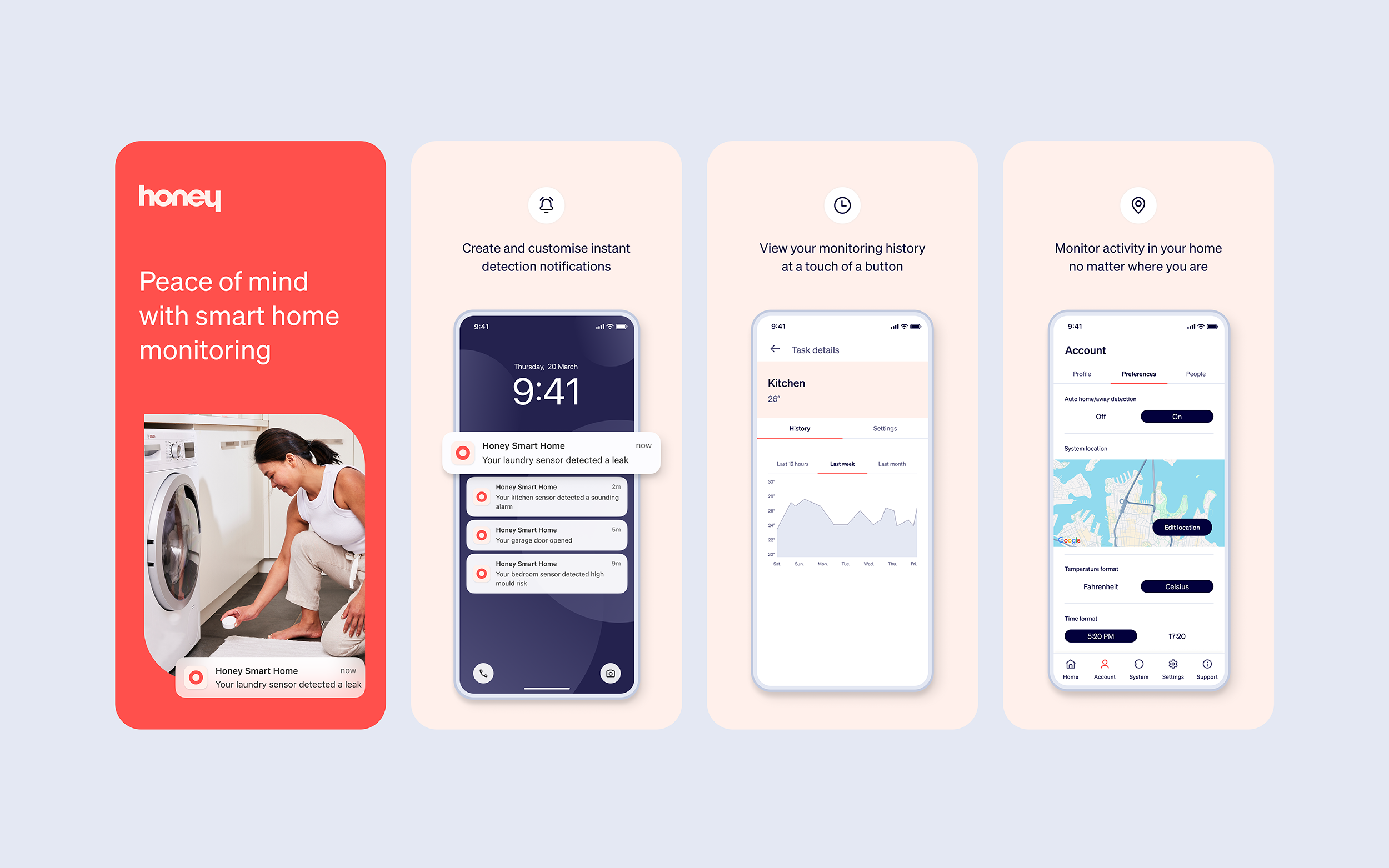
The Honey Smart Home app helps users manage sensors and monitor water leaks, doors and windows, smoke alarms, temperature changes and mould risk.
The smart home sensors are such a distinctive part of the Honey proposition. How has that landed with customers?
Hanne: Really well, but for different reasons than you might expect.
When we did our early research, we found that a big cohort of customers actually signed up because of the premium discount you get for activating the sensors. So, choosing us is still a very financially driven decision for a lot of people.
But there’s also a cohort who are genuinely excited about smart home technology; people who want more IoT devices in their home and see the sensors as innovative and interesting in their own right. And then there are the customers who’ve come back to us through reviews and support channels to say: the sensor went off, I caught a water leak before it became a flood.
That’s the win-win we were really going for.
Let’s talk about where your brand actually lives. When you have such a single-minded proposition, how do you maintain consistency across every touchpoint?
Hanne: This is something I feel really strongly about.
The product and design team at Honey is directly involved in shaping the brand experience across all touchpoints, including ones you might not expect us to be involved in.
For example, when we designed the digital sign-up experience, we simultaneously created the same flow for the customer support specialists in our contact centre; all of the scripting, the order of questions, the language used. That was all within the product team’s scope. And for things like email templates and complaints resolution, we collaborate closely with the operations team to make sure everything sounds the way we believe it should.
It helps that we’re a fairly small, tight-knit team. Everyone knows each other and is united in doing what’s best for the customer. And because we set that tone from day one, people naturally pick up on our brand personality pretty quickly. It’s part of our culture.
“Because we set the stage from day one, people are pretty well-trained in knowing our brand personality. It’s part of our culture.”
You invested in external specialists early on, even for things like tone of voice. Why was that a priority when you were already so aligned?
Hanne: Because we knew what we didn’t know. Where we didn’t have the expertise in-house, because we weren’t at a scale where that made sense, we brought in people who did, for animation, illustration, and tone of voice.
We worked with an external agency early on to really nail that. It’s easy to treat brand voice as something you figure out as you go, but we treated it as a craft from the beginning.
And I think that investment paid off. It’s part of why the brand feels consistent, even as we’ve scaled.
Trust in insurance is ultimately tested at claim time. What are you doing differently there?
Hanne: We’ve applied the same design thinking to claims that we did to the sign-up experience. It’s designed to be as easy and jargon-free as possible — you answer just enough questions for us to progress your claim quickly, rather than the cumbersome back-and-forth you get with a lot of other providers. The key principle is that customers should feel like we’re collecting information to help them, not just processing them.
Animated illustrations help create moments of delight when signing up for pet insurance.
Honey recently launched pet insurance. How did you approach building something new after the success of your other products?
Hanne: Pet insurance is such a different emotional experience to buy. With home insurance, especially if you have a mortgage, it’s a necessary purchase; it’s a task you need to complete, and the faster the better.
Pet insurance is much more of a considered, emotional purchase. People buy it because they want peace of mind, so that they can make decisions that are the best for their pet without having to put the costs of treatment first.
So, the whole tone shifts. With home insurance, speed and simplicity are your strongest messages. With pets, there’s so much more space to be warm, playful, even cute. We have built little barking sounds into our digital experience. It’s been genuinely joyful to work on.
And actually, the competitor landscape already tends to be a lot more playful in the pet category, even for traditional brands. So, what we were asking was: how do we go further? How do we make it extra cute, extra smart, whilst still feeling like Honey?
Speaking of ‘smart’, you decided not to include pet trackers in the product, even though it would’ve been an obvious extension of your sensor technology. Why?
Hanne: We took a very research-led approach. And what we learned was that trackers wouldn’t be universally relevant to our customer base. Cats and dogs have completely different needs. If we’re going to maintain a product like that, it needs to work for essentially all of our customers, not just a subset. So, we decided not to do it.
And I think that’s actually an important point about what ‘smart’ means. Smart doesn’t equal technology. Smart means doing the most sensible thing for your customer. Sometimes the right answer is a better price and a great experience, not more features.
“Smart doesn’t equal technology. Smart means doing the most sensible thing for your customer. Sometimes the right answer is a better price and a great experience.”
Where does AI fit into Honey’s future? It feels like an obvious fit for a category that’s famously hard to understand.
Hanne: It’s genuinely exciting territory for us.
Insurance is really hard to understand, and right now what a lot of people do is drop their PDS into an AI tool and ask it questions anyway. It would be so much more elegant — and so much better for the customer — if that experience was integrated directly into our product or website.
But we’re being careful. We’re a regulated industry, and the hallucination risk is still too high right now. The last thing we want is to tell a customer they’re covered for something they’re not, because the wording wasn’t precise enough.
That’s not a UX problem, that’s real harm.
So, we’re watching the space closely and waiting for the technology to mature to the point where we can do it responsibly. It will happen. Just not yet.
What advice do you have for marketers inside larger, more traditional financial services organisations who want to do things differently but keep running into roadblocks?
Hanne: Two things, really. First: back your idea with data. Customer research, analytics or some kind of initial indication that this is actually a good idea and not just something you’re excited about.
Talking to customers is often underutilised here. There are so many great insights available if you just ask.
But secondly, and this is where I see a lot of ideas fail, you need genuine business buy-in. Not just permission from one stakeholder, but real strategic alignment.
We ran a home services pilot a few years back. It was a beautifully designed concept where a branded technician would visit your home, check for maintenance issues that might affect your coverage, provide a detailed home service report with recommendations, and leave you with a gift. It was a very polished, well-considered experience that felt really personal but also novel. Our customers loved it but we couldn’t find a commercial strategy that worked and our priorities shifted, so we ultimately had to shelve it.
Desirability without viability and feasibility isn’t innovation; it’s a nice idea that goes nowhere. You have to think through all three. And if the commercial side isn't your strength, find someone in the business who can partner with you on it.
Is there also something in the timing too? Sometimes an idea isn’t wrong, it’s just early?
Hanne: Absolutely. And I think that’s an important thing to remember when an experiment doesn’t work. It doesn’t necessarily mean the idea was bad.
The market might not have been ready. The technology might not have been mature enough. Every failed experiment still gives you data, and sometimes that data is just: come back in five years.
Finally, what do you think will separate the insurers people genuinely trust from those they tolerate?
Hanne: Making the customer truly believe that you are helping them. Not as a line in an ad, but as something demonstrable in every interaction.
One area I feel really strongly about is climate risk. More and more Australians are living in areas that are becoming difficult to insure as fire and flood risks intensify. The easy response for insurers is to just decline cover. But I think that’s a really blunt instrument, and honestly, it’s not very inclusive to tell someone to just sell their house and move somewhere else.
There are organisations in Australia that help people who live in fire-prone or flood-affected areas to upgrade their homes and make them more resilient. If customers are taking those measures, insurers should be thinking about how to acknowledge that. How to continue to cover them, and how to be part of the solution rather than just closing the door.
That’s the version of insurance I’d love us to continue building toward. One where our customers continue to see we are invested in helping to avoid things from going wrong in the first place.
“That’s the version of insurance I’d love us to continue building toward. One where our customers continue to see we are invested in helping to avoid things from going wrong in the first place.”
Honey Insurance offers home, contents, landlord and renters insurance — and now, pet insurance — across Australia. Find out more at honeyinsurance.com